— Cultivation HVAC & Controls
A grow room is a climate problem before it's an HVAC problem.
For cannabis operators, indoor farms, greenhouses, research facilities — every controlled environment where climate is the crop. Argus certification. Forty years of mechanical HVAC. Both trades, one crew. Most controls integrators don't self-perform mechanical. Most mechanical contractors don't carry Argus. We do.

— The category
Cannabis. Produce. Research. Vertical farms.
Different buildings, same discipline — climate control tight enough to serve a live crop.
Controlled environment agriculture is a category, not a market. What ties it together is the room itself — sealed envelope, live plants, precision control on temperature, humidity, air movement, CO2, and light. "HVAC that happens to be in a grow room" is where most projects go wrong. The load looks like an office building until you add the transpiration curve. Then it doesn't look like anything you've seen before.
— Sub-markets we serve
Four buildings. One discipline.
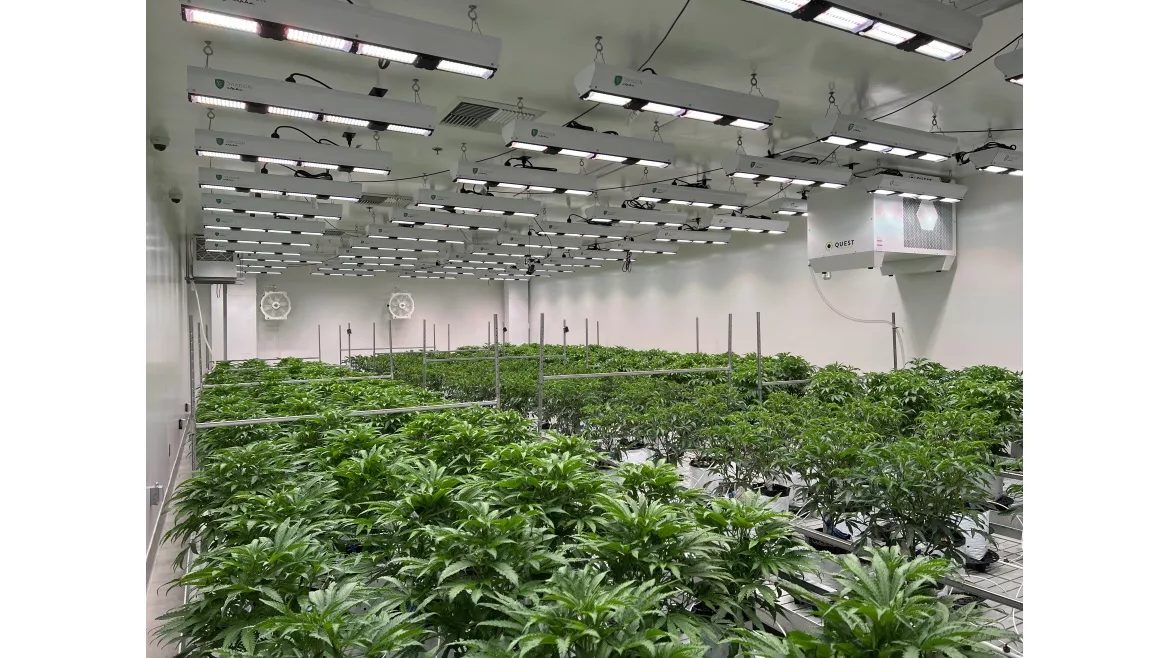
Cannabis grow operations.
Flower rooms, veg rooms, drying rooms. Regulated environments where temperature, humidity, VPD, CO2, and light schedules directly drive yield. Most projects are retrofits — old warehouses and industrial space — which means the mechanical envelope is fighting the process from day one.

Research + biopharma.
University plant science, USDA research, tissue-culture labs, seed-genetics facilities, cold-storage vaults. Tighter control tolerances than commercial grow. Regulated data-logging requirements. The mechanical side has to serve the science, not the harvest.

Commercial greenhouses.
Produce, ornamentals, propagation. Semi-open envelopes with active climate control. Fertigation and light supplementation matter as much as the mechanical side. Volume operations — the math is on cost per square foot, not per plant.

Vertical farms + indoor ag.
Hydroponic, aeroponic, aquaponic. Fully-sealed multi-tier growing. The mechanical problem is dense and repeatable — one zone design multiplied across floors. The controls problem is coordination — every tier talking to every other tier.
— The combination
One crew. Both trades. Under one roof.
Most controls integrators don't self-perform mechanical. They subcontract the HVAC or wait for the mechanical contractor to finish, then come in to program. Most mechanical contractors don't carry Argus certification. They install the equipment and hand off to whoever's doing the controls.
That handoff is where CEA projects lose money.
The controls team needs the mechanical sized right — for actual transpiration loads, not office-building assumptions. The mechanical team needs to know the controls sequence — because the sequence dictates equipment cycling, redundancy needs, and sensor placement. When they're different companies with different priorities, coordination gets expensive. Schedules slip. Sizing arguments happen after equipment is already bought. The owner watches from the middle.
We do both. Same people. Same schedule. Same accountability.
— Capabilities
What we install. What we control.
The mechanical side and the controls side, side by side. Neither delegated to a subcontractor.
— The mechanical (HVACD)
Equipment we specify and install.
Desert Aire (GrowAire / GreenAire / DriCure).
Purpose-built integrated HVACD units for indoor cultivation. Modulating hot-gas reheat coils that use waste heat from dehumidification instead of burning new energy. DriCure specifically for drying rooms — a room type most controls integrators ignore.
Bard wall-mounts.
Wall-mounted split systems for smaller cannabis facilities and modular buildouts. Fast install, dense capacity per unit. Works when roof-mounted RTUs aren't an option. Usually paired with dedicated dehumidification.
AAON rooftop units.
Custom-configured RTUs for larger CEA facilities. Sized for actual latent load, not office-building assumptions. When the roof can carry the weight and the building is new construction, AAON delivers.
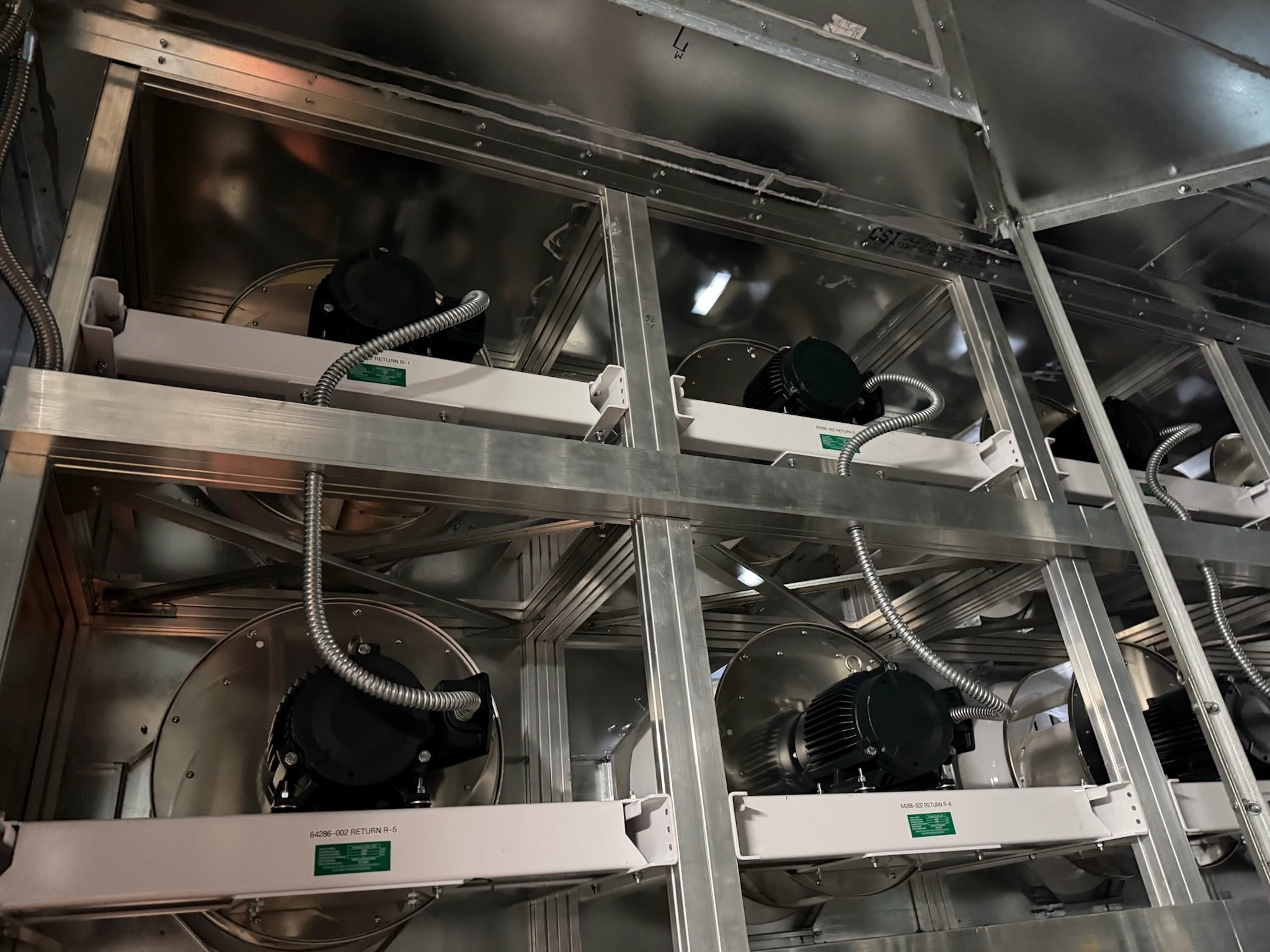
Fanwall arrays.
Modular blower arrays for high-airflow requirements. Redundant, quieter at part-load, efficient across a wide capacity range. Retrofits into existing air handlers without full unit replacement.
VRF (with a caveat).
Great for multi-zone commercial buildings. Not the right primary tool for a grow room — VRF is designed for sensible cooling, not moisture. Independent Desert Aire studies show VRF-plus-standalone-dehumidifier configurations use 15% more energy than integrated HVACD.
UV-C sterilization.
In-duct UV-C lamps for pathogen suppression. Coil-surface UV for biofilm control. A layer on top of filtration and IPM — especially useful in propagation and tissue-culture rooms.
— The controls (Argus)
Climate variables we manage.
Temperature.
Setpoints by growth stage. Cannabis flower typically 68–80°F, tighter for research, wider for commercial produce. Argus schedules per zone, per stage of the harvest cycle.
Humidity.
First-class setpoint, not downstream artifact. 40–70% RH depending on stage. Coupled directly to dehumidification demand. Mold above 70%. Dehydration below 40%.
VPD.
Vapor pressure deficit — temperature and humidity coupled as the plant experiences them. The single most important controls metric in a working grow room. Managed as a first-class setpoint.
Air movement.
Uniform airflow across the canopy is the difference between one bad plant and one bad batch. Fanwalls, HAF fans, canopy circulation. Argus coordinates fan zones so micro-climates don't form.
CO2 enrichment.
Target ppm typically 800–1500 during light hours. Injection sequenced by Argus. Ventilation and worker exposure limits enforced on schedule. Purge cycles between phases.
Light.
Spectrum, DLI, photoperiod, sunrise/sunset ramps. Programmed per zone in Argus. LED and HID/HPS shift the HVAC load calc — the mechanical design has to know which fixtures are in the room.

— The mechanical challenge
Dehumidification is the first hard problem. Everyone's second.
Plants transpire. Water goes up through the leaves and into the air. In a full-cycle cannabis flower room, that means 150–200 pounds of water per hour per 1,000 square feet of canopy. That is the mechanical challenge. Everything downstream depends on getting it right.
Traditional HVAC calcs miss this. They size for sensible load — the temperature swing — and treat humidity as a downstream artifact. In a grow room, that math produces an underdesigned dehumidification stack and a compressor cycling itself to death. Then a mold event happens. Then somebody calls us.
The other one is light-heat coupling. LED fixtures shift the load calc one way. HID and HPS fixtures shift it a different way. The mechanical design has to know what fixtures are in the room, in what quantity, on what schedule. If the fixtures change halfway through construction — which they always do — the HVACD has to accommodate. Only in-house mechanical can move that fast.
Make no mistake: the mechanical is the first design decision. Everything else follows it.
— What we bring
The credentials, the trades, the service department.
01
Argus certification.
Manufacturer-trained on the platform. Our controls engineers know Argus the way they know Schneider EcoStruxure or Niagara — every day, in the field, not just in the training module.
02
Mechanical + controls in-house.
Both trades under one roof, one crew, one schedule. No coordination tax between contractors. No sizing arguments after equipment has been bought.
03
Design-build capability.
Through our general contracting arm. The shell, the mechanical, the controls — specified together, built together. Not three vendors that met at the pre-construction meeting.
04
Service department.
Grow rooms need ongoing tuning. Recipes change. Fixtures change. Crops change. For the record: our service team owns the lifecycle, not just the install.
— See it in action
Two videos worth the time.
Argus Axia — Grow Control Platform
Climate Control in Indoor Agriculture
— Insights
Reading from the field.
I/A Series Niagara: Schneider’s Niagara system, explained.
Schneider sells a complete Niagara-based building management system under its own name. Here is what is in I/A Series Niagara, how it…
Read moreHackers turned up the heat.
Hackers pushed French supermarket freezers to 122°F through their controls. What that attack and others like it mean for your BAS security,…
Read moreAccess Expert or Security Expert? A field guide to Schneider’s two access control products (and who should install them)
Two Schneider access control products, one deep EcoStruxure Building Operation integration, one common installation mistake. A plain-English guide to Access Expert vs.…
Read moreCloud-managed BMS, explained — what Neeve actually does.
What a cloud-managed BMS actually is, what Neeve actually does, and where it fits — from an integrator that runs it on…
Read more— Reference material
The tables behind the recommendations.
For the deep readers — environmental targets, system comparisons, and the indoor-versus-greenhouse framework. Expand any panel for the detail.
Environmental targets by growth stage
| Stage | Temperature | Humidity (RH) | VPD | CO2 (ppm) | Photoperiod |
|---|---|---|---|---|---|
| Seedling / Clone | 72–78°F | 65–70% | 0.4–0.8 kPa | 400–800 | 18 / 6 |
| Vegetative | 70–85°F | 60–70% | 0.8–1.2 kPa | 800–1200 | 18 / 6 |
| Early Flower | 68–80°F | 55–65% | 1.0–1.3 kPa | 1200–1500 | 12 / 12 |
| Late Flower | 65–75°F | 40–50% | 1.2–1.6 kPa | 1000–1400 | 12 / 12 |
| Drying | 60–65°F | 55–60% | — | ambient | Dark |
| Curing | 60–70°F | 58–62% | — | ambient | Dark |
Sources: Desert Aire application notes AN25–AN35, Argus grow recipe libraries, and cannabis cultivation guidance from Anvil Agronomics / Zartarian Engineering (2023 cultivation HVACD study). Ranges shift by cultivar, growth medium, and light intensity.
Climate control system types compared
| System type | Best fit | Strength | Weakness |
|---|---|---|---|
| Split systems (mini-split) | Small setups, single zone, hobby-scale | Cheap, simple install, ductless | No native humidity control, limited capacity |
| Packaged rooftop (RTU) | Warehouses, mid-size retrofits | All-in-one, roof-mounted, familiar to most contractors | Not designed for CEA latent load without upgrades |
| Bard wall-mount | Small-to-mid cannabis retrofits, modular buildouts | Fast install, dense capacity per unit | Needs dedicated dehumidification alongside |
| VRF | Multi-zone comfort buildings | Precision sensible cooling, energy-efficient at partial load | Weak on moisture — needs standalone dehumidifiers, wider swings |
| Chilled water | Large multi-zone operations, vertical farms at scale | Industrial capacity, stable, deep zoning | High capital cost, complex install and commissioning |
| Integrated HVACD (Desert Aire class) | Commercial cannabis, high-density CEA, purpose-built facilities | Sensible + latent in one package, lowest total cost per crop cycle | Higher upfront capital, requires HVACD-fluent designer |
Comparison synthesized from Desert Aire's Cultivation HVACD System Comparison Study (2023, with Anvil Agronomics + Zartarian Engineering), Indoor Farming Hub HVAC system guidance, and Athena field experience.
Indoor vs. greenhouse decision framework
| Factor | Indoor (sealed) | Greenhouse |
|---|---|---|
| Setup cost | Higher — full envelope, mechanical, controls, lighting | Lower — envelope, supplemental mechanical, some lighting |
| Energy cost | Higher — all light and all HVACD is powered | Lower — sun does most of the lighting |
| Environmental control | Full — every variable programmable | Partial — natural weather influences setpoints |
| Yield consistency | High — no seasonal variation | Moderate — seasonal effects on cycle timing |
| Cannabinoid / terpene profile | Precise, tuned via CO2 and light spectrum | Broader profile from full-spectrum sunlight |
| Best when | Cannabis with tight quality targets, research, biopharma, indoor produce | Commercial produce, ornamentals, propagation, cost-focused operations |
Comparison drawn from Fluence Bioengineering and Amazol cannabis cultivation guidance. The choice usually comes down to product positioning (premium vs. volume) and local energy economics.
— Next step
Have a cultivation project?
Cannabis, greenhouse, vertical farm, research facility. New build, retrofit, ongoing tuning — whatever the stage, we can walk it. Argus controls plus the mechanical to back them. No queue. Real people.
— Other expertise
Explore the rest of what we do.
— Building Automation
Building Automation
We install and service Schneider, Johnson Controls, and Argus systems, natively or on Niagara, and we migrate legacy systems without ripping out the wiring.
Read more— Mechanical
Mechanical
We self-perform HVAC installation and service. It’s the trade Athena started with in 1984, and it’s still in our own hands.
Read more— General Contracting
General Contracting
We lead renovation and MEP infrastructure work in occupied buildings as general contractor or prime, and we carry every trade the job touches.
Read more— Security & Access
Security & Access Control
We install Schneider Access Expert and Security Expert, with card readers and mobile credentials tied into the BAS you already trust.
Read more— Service & Maintenance
Service & Maintenance
Multi-year contracts covering BAS and mechanical — scheduled visits, T&M, software upgrades, remote hosting, and the client portal that keeps your team ahead of the system.
Read more